

VPNs have long offered a convenient way for remote workers to securely access corporate systems. By encrypting traffic between users and the network, they allowed organizations to support remote work at scale, something that became especially important during the Covid-19 shift to home working.
However, the threat landscape around remote work is quickly evolving. Stolen credentials, session hijacking, multi-factor authentication (MFA) fatigue attacks, and compromised devices have all become common ways for attackers to gain access to corporate environments. Reinforcing this trend is Verizon’s 2026 Data Breach Investigations Report, which continues to identify credential abuse as one of the leading causes of breaches
That shift is forcing organizations to rethink whether traditional remote access models still provide the right level of protection.
The primary purpose of VPNs is to give trusted users a secure way to connect back to the corporate network from outside the office. Once authenticated, the VPN creates an encrypted tunnel between the user’s device and the organization’s internal environment, effectively extending the corporate network to wherever that employee is working.
From a productivity perspective, VPNs have operational advantages; employees can reach internal systems as if they were physically in the office, and administrators can manage infrastructure remotely. But from a security perspective, the same level of access that makes VPNs convenient can also increase the impact of a security incident. If attackers exploit a vulnerability or compromise a user account, VPN access can give them a direct path into large parts of the corporate network.
That risk has been highlighted repeatedly in recent years through vulnerabilities affecting widely used VPN platforms. One notable example was CVE-2024-21888, a privilege escalation flaw in IT software company Ivanti’s Connect Secure and Policy Secure services. The vulnerability allowed attackers to elevate privileges to administrator level, potentially giving them broad control over affected environments.
Zero Trust Network Access (ZTNA) takes a fundamentally different approach to remote access security than traditional VPNs.
Instead of placing users onto the corporate network after authentication, ZTNA grants access only to the specific applications or services a user is authorized to use. Access decisions are based on identity, device trust, location, security posture, and other contextual signals, and those checks continue throughout the session rather than happening once at login.
That approach aligns closely with the core principle behind zero trust security: never trust, always verify. Applied to network access, users don’t receive broad connectivity simply because they are successfully authenticated. A finance employee may be allowed to access an internal payroll application, for example, but not development systems or infrastructure management tools sitting elsewhere on the network.
Furthermore, if credentials are only part of the authentication process, that dramatically increases the difficulty attackers have in successfully compromising an account. For instance, tying accounts to specific devices means an attacker would need valid credentials and access to the associated hardware.
For many modern remote access scenarios, ZTNA provides stronger security controls than traditional VPNs. But that doesn’t mean VPNs are disappearing entirely. Infrastructure teams, network engineers, and administrators need visibility across systems to maintain internal services and troubleshoot issues. Some older applications and protocols also rely on network-level connectivity and are difficult to modernize without significant cost or operational disruption.
For many organizations, those legacy systems now sit alongside cloud platforms and modern software-as-a-service (SaaS) applications, creating mixed environments where a single remote access model does not always fit. Fully replacing VPNs may therefore be unrealistic in the short term, particularly in industries that rely on operational technology, heavily customized internal systems, or infrastructure with strict uptime requirements.
As a result, adopting a more selective approach to remote access rather than treating VPNs and ZTNA as mutually exclusive technologies may provide the best way forward. That might look like:
For most organizations, the long-term direction is still toward more granular, identity-aware access controls. But in practice, VPNs are likely to remain part of the remote access stack for some time, especially where operational requirements still depend on network-level connectivity.
Organizations reviewing their remote access and identity security strategies should focus not only on connectivity, but also on how access is granted, monitored, and controlled across networks.
Specops Device Trust helps strengthen that process by bringing device trust into authentication decisions. Rather than relying solely on credentials and MFA prompts, it allows organizations to verify whether the device attempting to access corporate systems is trusted and compliant.
That includes checking device posture during login and continuously validating compliance throughout active sessions through regular device scans. Where devices fall out of compliance, rapid self-service remediation means users can quickly fix issues without involving the IT team, with grace periods to reduce friction.
Specops Device Trust
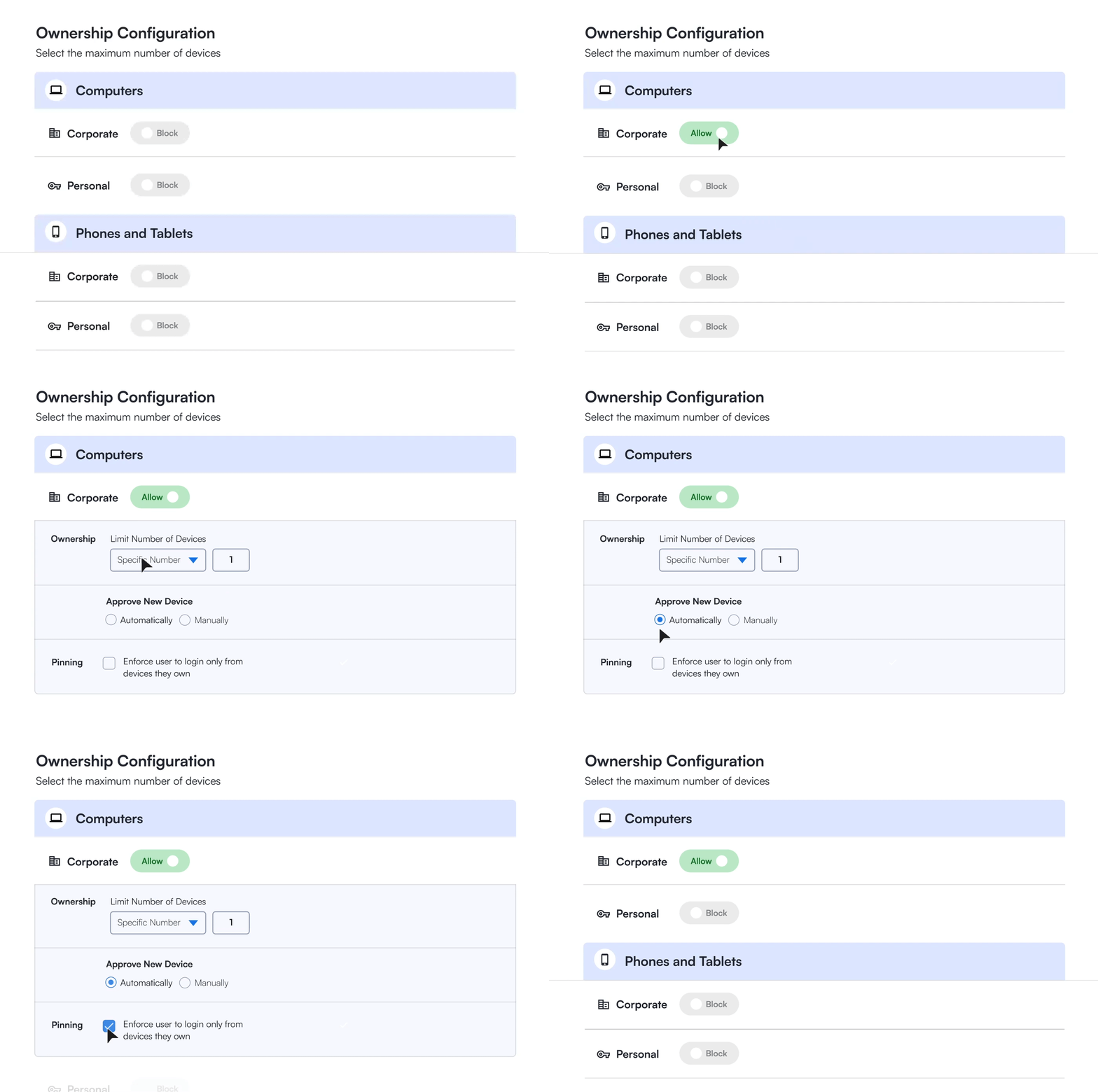
Specops Device Trust also binds identities to specific, trusted devices, preventing account takeovers from attacker-controlled hardware. Coverage extends across Windows, macOS, Linux, iOS, and Android, ensuring that every device, including BYOD and contractor devices, authenticates securely. This is especially useful in mixed environments where ZTNA and legacy VPN access are deployed together.
Specops Device Trust delivers an important part of a zero-trust strategy by applying stronger identity and device-based access controls. For organizations looking to reduce reliance on broad network access without completely redesigning their remote access infrastructure, that provides a practical step toward aligning security policies with zero trust principles.
If you’re looking to evolve your identity security strategy to bring zero trust into workforce access decisions, contact Specops and speak to an expert.